The Power of Herd
Why intelligent people follow the crowd – and why it can be especially dangerous when it comes to our money.
By: Philip “Flip” O’Toole, CIMA®
A Thought Experiment
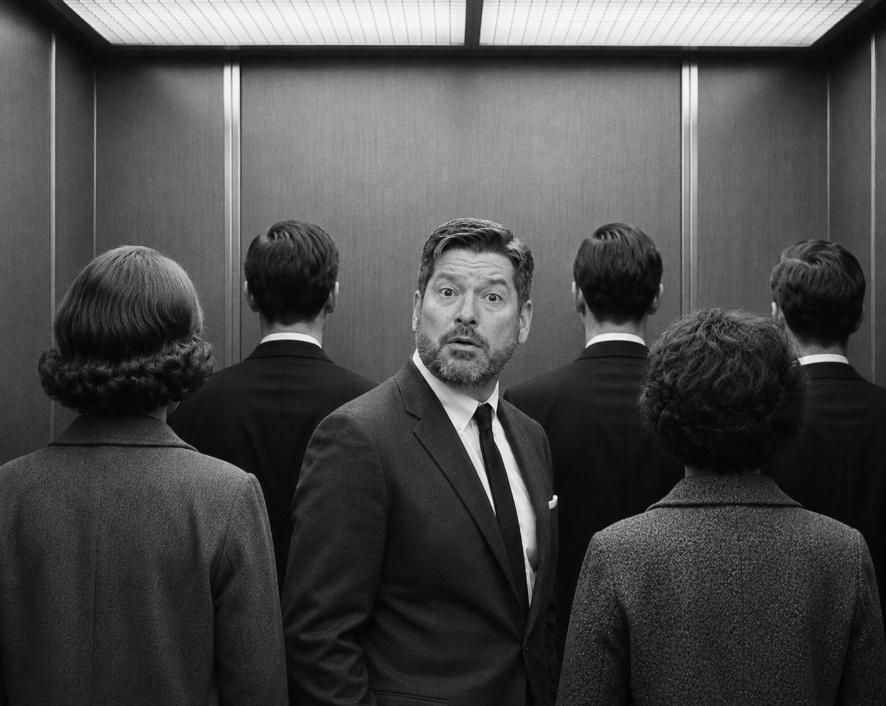
Imagine you are leaving a meeting on the 20th floor of a downtown high rise office building. The elevator makes five stops on its way down to the lobby. At each stop, one new person gets on the elevator and instead of turning to face the front doors of the elevator, each chooses to face the back wall.
You know how an elevator works. You have ridden hundreds of them and have always faced the front doors. And yet after five strangers step aboard and face the back wall, something strange happens: you begin questioning yourself.
“What do they know that I don’t”
You rock back and forth, check your watch, and scroll through your iPhone. Eventually, do you slowly and inconspicuously turn around and join them?
How do you think the average person would react?
In 1962, the hidden-camera television show Candid Camera in a hilarious scene titled Face the Rear demonstrated in a real-life elevator experiment that humans are indeed wired to conform with the crowd, even against our better judgement. Subject after subject had difficulty resisting the crowd and one-by-one slowly turned to face the back wall. You can Google it…
Candid Camera often served as an experiment into the absurdity of human behavior. This scene demonstrated something important: herd mentality can cause people to question their own experience and wisdom simply because everyone around them is doing something different.
Why are We Tempted to Follow the Crowd?
Psychologists define herd mentality as “the tendency to follow the actions of a larger group rather than rely on our own independent judgement”.
The subjects on Candid Camera didn’t follow the crowd because they were not intelligent. They followed because they were human.
Herding isn’t necessarily a failure of intelligence. It can be a failure of independent judgement under social pressure.
In the 1950’s, psychologist Solomon Asch demonstrated this through his famous conformity experiments. Subjects were shown a target line and asked which of three other lines matched its length. The answer was obvious.
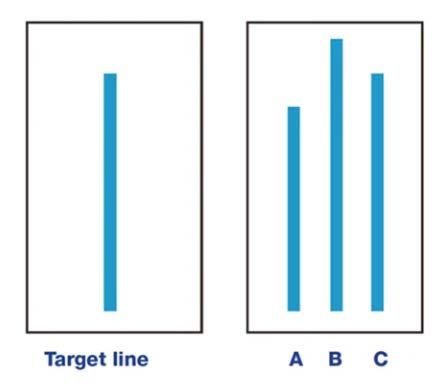
But there was a catch.
Everyone else in the room was part of the experiment. When the group confidently gave the same obviously incorrect answer, subjects frequently began questioning what they could see with their own eyes.
Why?
Because disagreement is uncomfortable. Standing alone is uncomfortable. We begin to wonder:
"What do they know that I don't?"
Sometimes we choose the comfort of belonging over our own better judgement.
To be clear, conforming with the crowd is not always bad. Herd mentality can result in a positive outcome. For example, it is a good idea to join everybody running out of a burning building.
But planning and investing are not burning buildings.
Sometimes, crowds are not reacting to facts. They are reacting to one another.
And following an emotional herd can be devastating.
Herd Behavior in Everyday Life
Once you understand herd behavior, you start to notice it everywhere - especially if you have a teenage daughter. If you don’t believe me, head up to a high school football game some Friday night and you will quickly know what the “uniform” is this fall.
Or remember the Spring of 2020 and the run on toilet paper. People didn’t suddenly need more toilet paper. They were reacting to the behavior of others and feared being the only family left shortchanged.
Yankees Hall-of-Famer Yogi Berra famously said about a New York restaurant, “Nobody goes there anymore. It’s too crowded.” Like many Yogi-isms, the quote makes no sense and perfect sense at the same time.
Crowds attract crowds until they suddenly do not.
And therein lies the danger. Herd behavior isn’t merely about why people pile into something. It’s also about what happens when the crowd simultaneously decides to leave.
If herd behavior can influence the direction we stand in an elevator, the outfit we wear to a high school football game, or how much toilet paper we buy, can it also influence decisions we make about our money?
Unfortunately, the answer is yes.
Herd Behavior in Wealth Management
When it comes to money, Benjamin Graham famously said our “chief problem-and even worst enemy-is likely to be ourselves.”
The historical examples of crowd-chasing in financial planning and investment management are too many to list. The book Extraordinary Popular Delusions and the Madness of Crowds by Charles Mackay, first published in 1841, remains a timeless reminder that human folly involving money is not exactly modern phenomenon.
But herd mentality doesn’t only reveal itself when investors chase the latest hot stock, cryptocurrency or investment strategy. It can quietly influence some of the big financial-planning decisions of a family.
“Everyone I know is waiting until 65 to retire when Medicare kicks in. Shouldn’t I?”
“Everyone says I should max out my pre-tax 401k.”
“Our friends are all buying second homes. Maybe we should too.”
“Everyone says you should delay Social Security until age 70.”
None of these decisions are inherently right or wrong.
The mistake is allowing what is right for the crowd to substitute for determining what is right for you.
Wealth Management is deeply personal. Two families with similar incomes and net worth can rationally make completely different decisions because they have different goals, tax situations, spending needs, family circumstances and dispositions.
Herd mentality can cause us to substitute the crowd’s plan for our own.
Investment management presents a similar problem.
Warren Buffet famously advised investors to “be fearful when others are and greedy and greedy when others are fearful”.
Many humans, however, seem wired to do the opposite. I have cited the DALBAR study multiple times in this space. Its research has consistently demonstrated the damage investors can inflict upon their own returns through poorly timed decisions – getting greedy and buying after markets have already rallied or fearful and selling after they have fallen.
But investing creates an additional problem with herd behavior.
In everyday life, popularity can be useful information. A restaurant with a two-hour wait may be evidence that it is excellent.
But investments have prices.
As investors pile into the same investment, its price can rise along with the expectations embedded in that price. What is becoming more popular can simultaneously become less attractive.
That makes distinguishing between what is popular and what is valuable especially important.
Distinguishing Between What is Popular and What is Valuable: The Antidote to the Herd
The late Charlie Munger, Warren Buffett’s right-hand man at Berkshire Hathaway for 45 years, described several mental models they used in their decision-making process throughout their stellar careers. One of his favorites was inversion.
Instead of asking “how do I succeed?” inversion asks:
“What would guarantee failure?”
Then avoid those things.
Inversion is particularly powerful against herd behavior because it interrupts the question our brain instinctively wants to ask.
When the crowd is doing something compelling, we naturally wonder:
“What do they know that I don’t?”
Instead, invert the problem and ask:
What would have to be true for the crowd to be wrong?
What am I assuming simply because everyone else seems to believe it?
And perhaps most importantly:
If nobody else were doing this, would I still want to do it?
If none of my friends owned a second home, would I still want one? If none of my co-workers were waiting until 65 to retire, would 65 still be my number? If nobody was talking about this investment, would I still find the economics compelling?
The purpose of inversion is not to automatically do the opposite of everyone else. Blind contrarianism is simply another way of allowing the crowd to dictate your behavior.
The goal is not to go against the crowd. The goal is to think independently of the crowd.
The next time the crowd is pulling you toward a financial decision, picture yourself back on that elevator. Everyone else is facing the rear. You alone are facing the front doors. Before you turn around, ask yourself one question:
If nobody else were doing this, would I still believe it was the right decision for me?
Sometimes the answer will be yes. And sometimes the smartest thing to do is to stay independent of the crowd and face the front doors.
The views and opinions expressed herein are those of the author(s) noted and may or may not represent the views of Lincoln Investment. These views are as of July 16, 2026 and are subject to change based on subsequent developments. The material presented is provided for informational purposes only. Information is based on sources believed to be reliable; however, their accuracy or completeness cannot be guaranteed. Nothing contained herein should be construed as a recommendation to buy or sell any securities. As with all investments, past performance is no guarantee of future results. No person or system can predict the market. All investments are subject to risk, including the risk of principal loss.